
Olympic Athletics Events Explained: Sprints, Distance, Field and Combined
Olympic athletics events are the original heart of the Games — running, jumping and throwing are the oldest contests in sport, and the athletics stadium still produces the moments the whole world stops for. But the programme is large, and to a casual viewer one final can blur into the next. The way to make sense of it is to sort the events into their families: sprints, middle and long distance, hurdles and steeplechase, relays, jumps, throws, combined events and the road races. Each family rewards a different body and a different kind of courage, and together they explain why athletics crowns so many different kinds of champion in a single week.
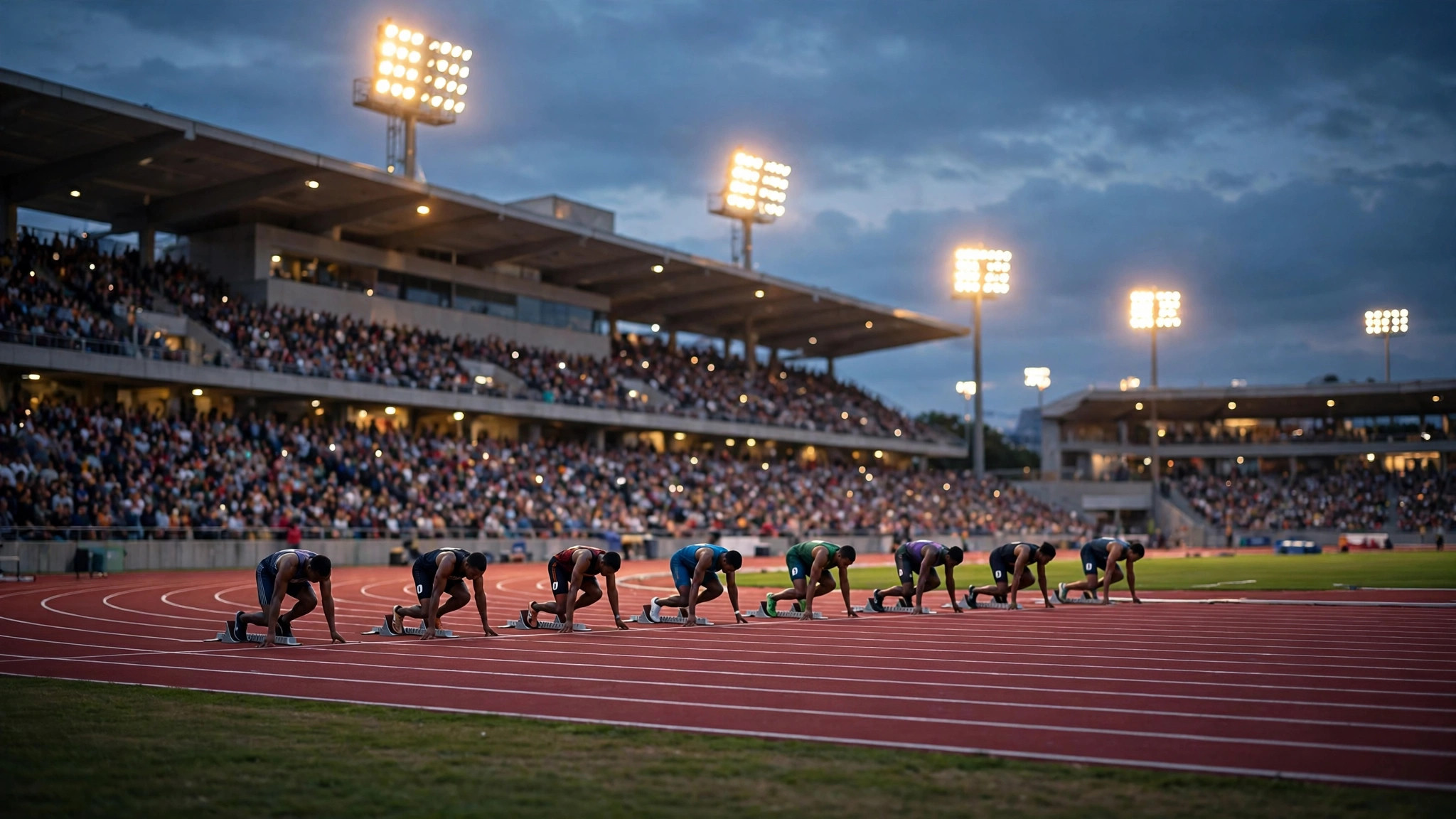
The sprints are the shortest and most explosive: 100 metres, 200 metres and 400 metres. The 100 metres, decided in under ten seconds, is the most prestigious individual title in the Games — the fastest man and fastest woman on Earth. Reaction time, drive out of the blocks and top-end speed decide it, and the final is built around a single gun rather than rounds of heats on the day itself. The 200 metres adds a bend to run, while the 400 metres, a full lap, sits at the agonising border between sprinting and endurance, where athletes must judge how much speed they can carry before the lactic acid arrives in the home straight.
Middle-distance races — 800 and 1500 metres — are tactical chess at running speed. Nobody can sprint the whole way, so positioning, patience and the timing of the final kick decide medals; championships races are often slower than qualifying rounds because nobody wants to lead into the wind. The long-distance events, 5000 and 10,000 metres, stretch over twelve-and-a-half and twenty-five laps, testing aerobic power and the ability to change pace repeatedly. Add the hurdles, where rhythm between barriers matters as much as speed, and the steeplechase, with its water jump per lap, and the track programme alone could fill the Games.
Field events and relays: the other half of Olympic athletics events
The field events split into jumps and throws. The jumps are the high jump, where athletes clear a bar using the backwards Fosbury Flop; the pole vault, the highest of all, combining sprinting, gymnastics and nerve; and the long jump and triple jump, where speed down the runway converts into distance in the sand. The throws are shot put, discus, hammer and javelin — four implements, four techniques, one principle: build rotational or linear speed through the body and release at the perfect angle. Field finals are slow-burn dramas, with six rounds of attempts and the lead changing on the last throw.
The relays — 4×100 and 4×400 metres — are the only team events on the track, and they add a skill pure running cannot teach: the baton exchange. In the 4×100, exchanges happen at full speed inside a marked zone, and favourites regularly lose gold medals to a fumbled handover. The 4×400, four laps of one athlete each, often closes the programme with a rolling, roaring finale. Mixed-gender relays have recently joined the schedule, adding another tactical puzzle.
The combined events test everything at once. The men’s decathlon runs ten events over two days — sprints, jumps, throws and a 1500 metres to finish — and its winner is traditionally called the world’s greatest athlete. The women’s heptathlon covers seven events on the same principle. Points tables convert every performance into a score, so a javelin throw and a sprint can be compared in a single currency. Beyond the stadium, the road programme adds the marathons and race walks through the host city’s streets.
All of it is governed by the sport’s world body World Athletics, which sets the rules, implements and records. The athletics week also sits at the very top of global viewing figures, as our ranking The Biggest Sporting Events in the World, Ranked by Viewership makes clear. If you are new to the Games, start with the 100 metres finals, then let one field event — the pole vault is usually the best theatre — pull you in. The families will sort themselves out from there.
Records and moments that define Olympic athletics events
Part of the programme’s magic is that it keeps a single record book across generations. A world record set in a sprint or a jump can be compared with marks from decades earlier in a way few sports allow, because the distances and implements barely change. That continuity is why certain numbers — the height of a famous high jump, the distance of a legendary long jump — live in the memory of people who never saw them live. It also raises the stakes of every final: athletes are not only racing the people beside them, they are racing history, and the stadium knows it. When a record does fall in an Olympic final, the roar is different in kind, not just in volume — the sound of a whole sport updating its idea of what is possible.